
How does the Venus flytrap detect its prey? A 2025 study sheds light on its ‘sixth sense’
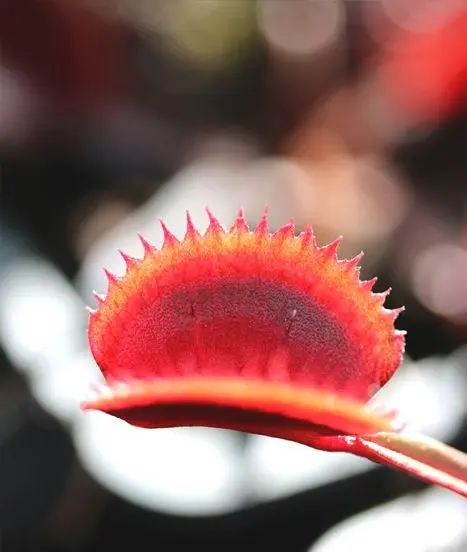
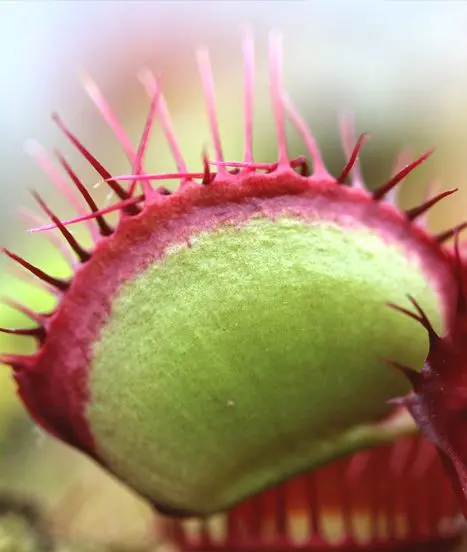
A team of Japanese researchers (from Saitama University) has just unravelled a mystery that has puzzled scientists ever since Darwin: how does the Venus flytrap (Dionaea muscipula) manage to detect the slightest brush of an insect, without a brain or a nervous system? The answer lies in a gene, named DmMSL10, which acts as a true tactile sensor at the cellular level.
A mechanism already known, but incomplete
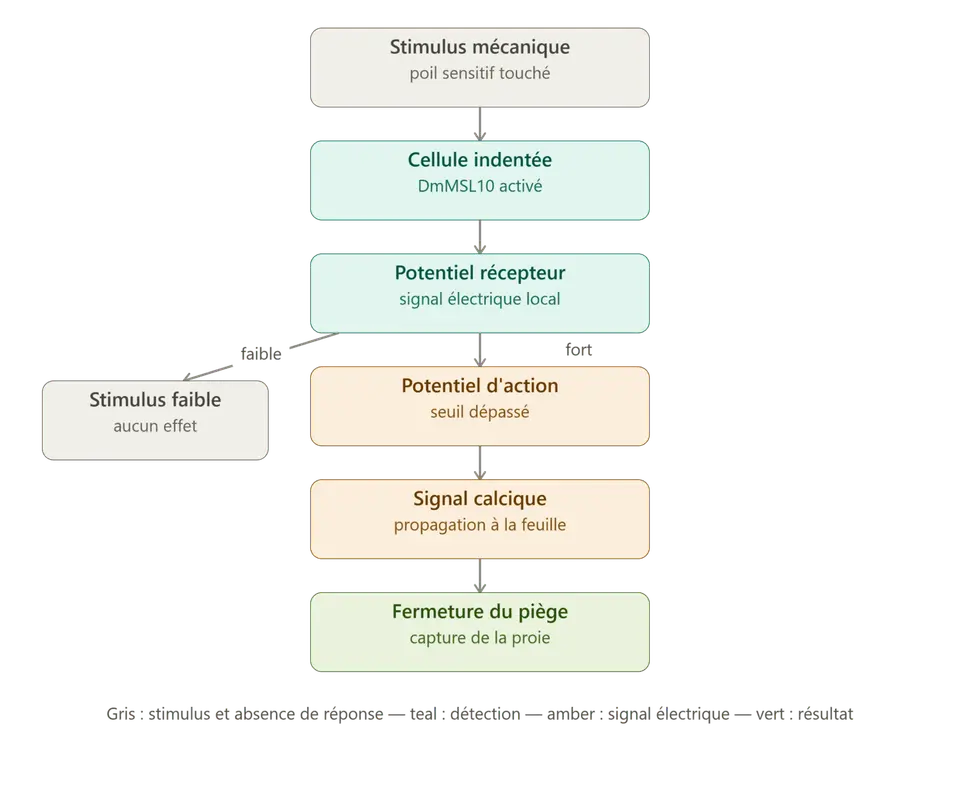
It has long been known that the Venus flytrap closes after two successive stimulations of its sensory hairs, in less than 30 seconds. This mechanism protects the plant from false alarms (a raindrop, a blade of grass) whilst enabling it to capture its prey with formidable efficiency. But the question remained: what molecular mechanism transforms a simple physical contact into an electrical signal?
DmMSL10, the sensor that changes everything
By observing genetically modified Venus flytraps under a microscope, the researchers identified a protein, DmMSL10, located in the cells at the base of the sensory hairs. This protein acts as an ultra-sensitive switch: as soon as even the slightest mechanical pressure is exerted on the hair, it triggers a local electrical signal, which — if the stimulus is strong enough — spreads throughout the entire leaf.
A key finding was that plants in which this gene had been deactivated lost some of their ability to detect prey. In tests with live ants, the ‘blind’ traps (without DmMSL10) reacted 18.5 per cent less often to the presence of an insect than normal plants.
Key point: the Venus flytrap does not ‘smell’ its prey like an animal — it detects mechanical pressure via a specialised protein, DmMSL10, which works in much the same way as the tactile receptors in our own skin.
Why this discovery is important
Beyond scientific curiosity, this study sheds further light on the evolutionary origins of the sense of touch — a sense previously thought to be unique to the animal kingdom. For enthusiasts of carnivorous plants, it confirms above all just how much the Venus flytrap is a precision mechanism, shaped by millions of years of evolution to detect the slightest movement in its environment.
Would you like to observe this mechanism at home?
If you’re growing a Venus flytrap, you can observe this phenomenon first-hand: a gentle brush of your fingertip against a sensitive hair, repeated once more, is enough to trigger the trap to close. To look after your plant and see it close its trap in the best possible conditions, check out our comprehensive care guide for Dionaea muscipula.
Don’t have a Venus flytrap to observe yet? Discover our selection of Venus flytraps available for sale.
Source: Suda, H. et al. “MSL10 is a high-sensitivity mechanosensor in the tactile sense of the Venus flytrap.” *Nature Communications* 16, 8280 (2025). DOI: 10.1038/s41467-025-63419-w

For sale in the Karnivores shop
Love Carnivorous plants? Don't miss our plants and exclusive offers in the online shop.
Read next
Saxifraga candelabrum: the flowering plant that confirms a 150-year-old hypothesis by Darwin
Growing Tillandsia from seed: a comprehensive guide to successful germination

Do Dionisian traps run on electricity?
How carnivorous plants digest their prey

Which plants can you grow on xaxim?
When should you sow seeds of carnivorous plants?