
Do Dionisian traps run on electricity?
Introduction
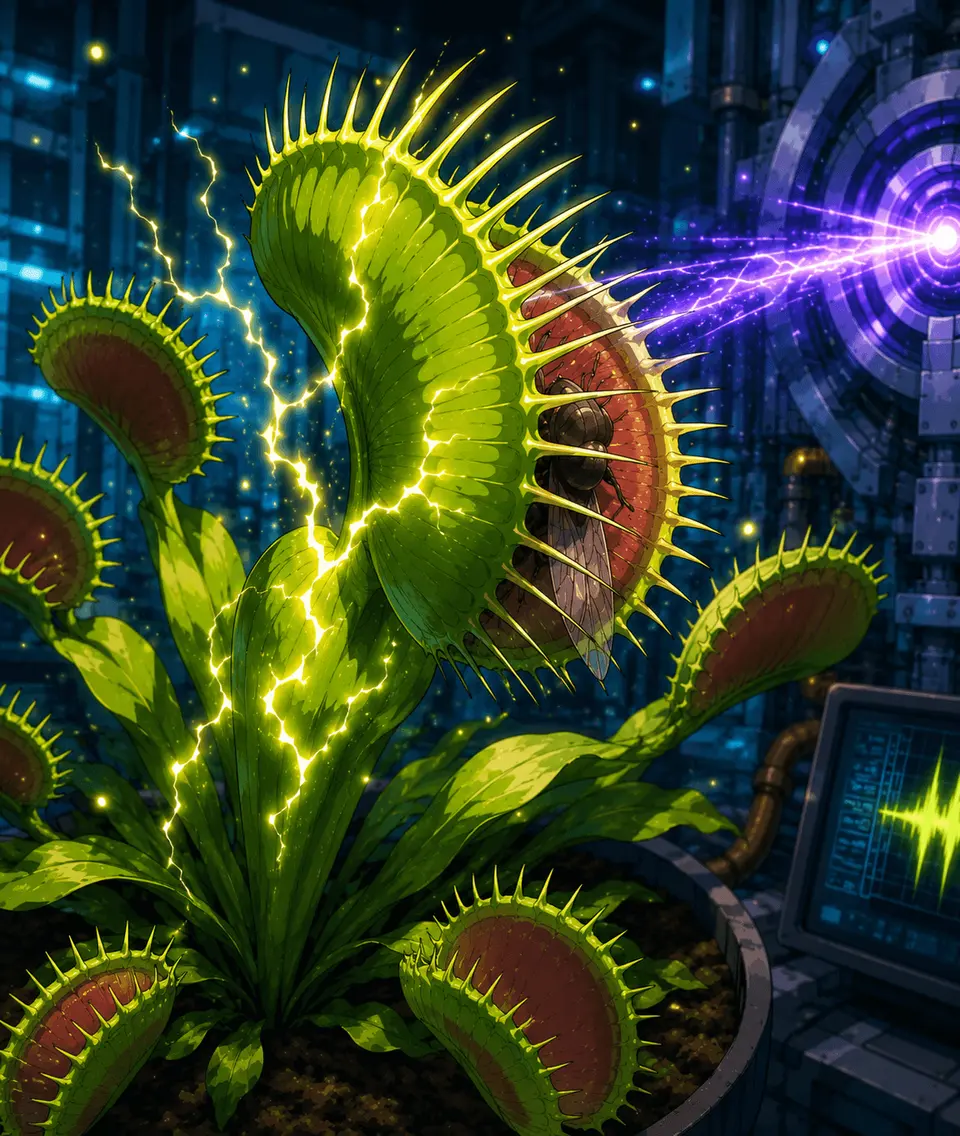
Dionaea muscipula, better known as the Venus flytrap, is one of the most fascinating carnivorous plants in the world. Capable of snapping its traps shut in a fraction of a second, it intrigues both botany enthusiasts and scientists alike. But behind this spectacular movement lies an even more astonishing reality: the Venus flytrap’s traps function partly thanks to electrical signals.
Contrary to what one might think, the closing of a trap is not merely a mechanical process. The plant uses a complex system based on ion exchange, the movement of water within its cells and action potentials comparable, in principle, to certain electrical phenomena observed in animals.
How does a Venus flytrap’s trap work?
Inside each trap are small sensory hairs. When an insect touches these hairs, the plant immediately detects this mechanical stimulus. This contact then triggers an electrical signal called an ‘action potential’, which spreads rapidly through the trap and causes it to close.
The Venus flytrap also possesses a very short-lived form of ‘memory’. Generally, a single touch is not enough to trigger closure. Two rapid successive stimuli are required to prevent a raindrop or a piece of debris from causing an unnecessary closure.
The speed of the movement is due to pressure changes within the plant’s cells. The movement of ions and water abruptly alters the shape of the trap, which then snaps shut in a few tenths of a second.
A far more complex reaction than it appears
The closing of the trap is only the first stage. In carnivorous plants, a simple mechanical stimulus can trigger a series of electrical and hydraulic reactions causing the trap to close. If prey is present, the plant then activates enzymatic mechanisms to digest it.
Scientific experiments have also shown that it is possible to trigger the closure of a Venus flytrap without an insect present, notably by applying a weak electric current or through certain physical disturbances. Some more recent experiments shared online even show reactions following exposure to ionising radiation or particle beams.
The plant obviously does not ‘see’ these particles. However, these disturbances can alter ion exchange within the cells and artificially trigger the electrical signal responsible for closing the trap.
Conclusion
The traps of Venus flytraps therefore function, in part, thanks to electricity. Electrical signals play a vital role in detecting prey and triggering the closing mechanism.
This ability serves as a reminder of just how complex plants are as organisms. Without a brain or a nervous system, Venus flytraps are still capable of sensing their environment, transmitting internal signals and coordinating extremely sophisticated biological responses.

For sale in the Karnivores shop
Love Carnivorous plants? Don't miss our plants and exclusive offers in the online shop.
Read next
Saxifraga candelabrum: the flowering plant that confirms a 150-year-old hypothesis by Darwin
How does the Venus flytrap detect its prey? A 2025 study sheds light on its ‘sixth sense’

Growing Tillandsia from seed: a comprehensive guide to successful germination

How carnivorous plants digest their prey

Which plants can you grow on xaxim?
When should you sow seeds of carnivorous plants?