
Dionaea: A comprehensive guide to caring for your carnivorous plant
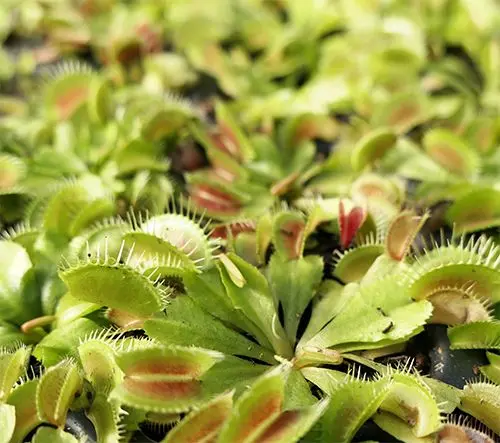
Dionaea muscipula, commonly known as the ‘Dionaea’ or ‘Venus flytrap’, is a carnivorous plant about ten centimetres in diameter and is one of the most fascinating plants in existence. It is equipped with traps that snap shut in a few tenths of a second when an insect enters them. The insect is detected by small sensory hairs, which trigger the trap to close after two touches. The prey is thus trapped and then digested by an enzymatic fluid that dissolves its flesh. The resulting nutrient-rich ‘soup’ is then absorbed into the plant’s tissues.
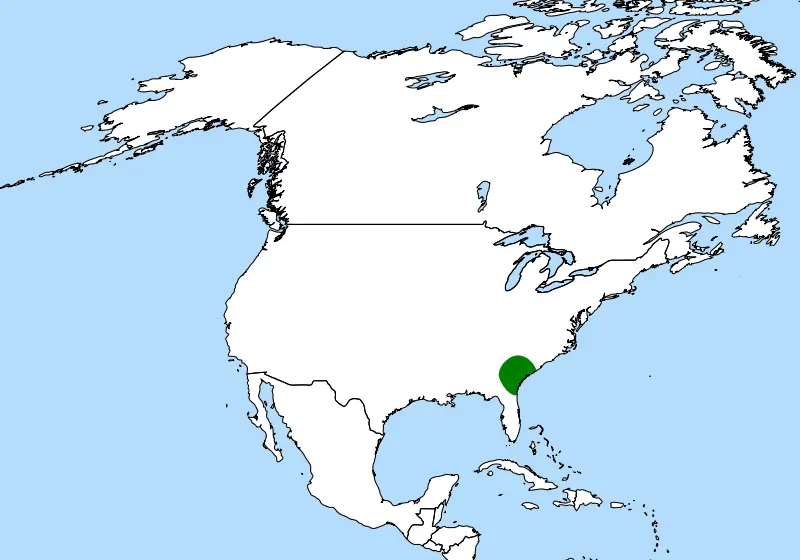
This carnivorous plant grows exclusively in a few peat bogs in North and South Carolina, in the United States, in a temperate to subtropical climate.
There is only one species of Dionaea (Dionaea muscipula), but there are numerous variations, which make growing this plant all the more fascinating.
They are indeed very diverse, both in terms of colour and morphology. We have selected several that are remarkable for their very distinctive characteristics. Note the deep red colour of the ‘Dionaea Akai ryu’ cultivar!
Growing and caring for Dionaea muscipula
Best practices for growing
- Grow the plant outdoors or in a conservatory or cool greenhouse during winter, ensuring it receives as much sunlight as possible and without worrying about the ambient temperature.
- Use a mix based on blond peat (a special mix forcarnivorous plants) or sphagnum moss.
- Keep the growing medium very moist from spring to autumn, using rainwater, demineralised or reverse-osmosis water, and only use other types of water in the event of a shortage.
- Use a large plastic pot with drainage holes, placed on a saucer to facilitate watering.
- Allow the insects to trap themselves.
Cultivation practices to avoid
- Growing the plant indoors all year round in a dimly lit spot, or bringing it indoors as soon as the weather turns cold.
- Using standard potting compost, garden soil or other garden centre compost.
- Watering with tap water, spring water or mineral water, or water from a stream or river (which may be hard or polluted).
- Constantly move the plant around, or repot it several times a year.
- Feed it by hand with meat or give it fertiliser.
- Read on for all the details…
Choosing how to grow it
The Venus flytrap is considered an easy-to-grow carnivorous plant, as it adapts quite well to our climate. You might want to grow it indoors to keep it close by, but this isn’t ideal for the plant itself. Native to North America, it isn’t suited to a tropical climate. It needs seasonal temperature variations, such as those found in our part of the world. Furthermore, it is much more attractive and vigorous if given as much sun as possible. It’s no secret, then: the Venus flytrap is best grown outdoors, or in a cool greenhouse or conservatory during winter.
Choosing the pot and growing medium
The pot must have drainage holes and be made of plastic, as terracotta retains all the minerals, which then become concentrated in the soil. As with most carnivorous plants, its growing medium should consist of light-coloured sphagnum peat mixed with materials that provide drainage and aeration to allow the roots (and the peat itself) to breathe: perlite, vermiculite, quartz sand… It is important not to use calcareous materials. Sphagnum moss can also be used as a growing medium; it is very healthy due to its acidic properties and has good water retention. Using a large pot provides a level of comfort that the plant appreciates in winter: a large volume, due to its thermal inertia, helps to reduce the impact of the cold on the roots.
Of course, it gives the plant more space to grow, which means you won’t have to repot it every year. In the event of prolonged severe frosts (below -5°C), the pot can be wrapped in bubble wrap and covered with a plastic cloche or wintering fleece. Moving the plant to a sheltered spot is beneficial and will not cause it any stress.
Watering with the right quality and quantity
Watering can be done via a saucer placed beneath the pot, using only rainwater, demineralised water or osmosis water. Any other type of water can be harmful in the long term, as it loads the soil with minerals; the worst culprit is hard water, which suffocates the roots. From spring to autumn, when the saucer is empty, you should top up the water. You can also water from above and/or let the rain do the job. During this period, you must never let the soil dry out.
From November onwards, and until March or April depending on the region, simply check that the soil does not dry out completely. The plant does not need heavy watering, as its growth has completely stopped: it is in winter dormancy! Too much water can actually be dangerous in freezing conditions: the pot must not resemble a frozen puddle. The roots and the pseudobulb would not appreciate this. If necessary, when there is no frost, you can add a little water from above.
Common problems with Dionaea muscipula and their solutions
Here is a summary table of the most common problems affecting Dionaea muscipula and their solutions, to help you diagnose and save your plant in the blink of an eye.
| Problem observed | Probable cause | Recommended solution |
|---|---|---|
| The traps turn black quickly | Natural ageing or excess moisture / root rot | Cut away dead traps, aerate the growing medium, repot if necessary using a mixture of light-coloured peat and perlite, and use only rainwater. |
| The traps no longer close | Lack of light, plant fatigue or too much manual stimulation | Place the plant in full sun (at least 5 hours a day), avoid ‘playing’ with the traps, and let the plant recover. |
| The leaves are becoming limp or wilted | Waterlogged compost, standing water or lack of light | Check the drainage, reduce watering slightly, and place the plant in direct light. |
| The plant is no longer producing new traps | Natural winter dormancy or lack of light | If it is winter, allow the plant to rest at 5–10 °C. Otherwise, increase the light levels or use a grow light. |
| The traps remain green, without turning red | Lack of sunlight or excessive humidity | Place the plant in full sun, reduce the humidity slightly, and avoid keeping it under a cloche. |
| Moss or algae appearing on the growing medium | Stagnant Eau and lack of aeration | Remove the moss, change the water in the saucer more often, and repot if necessary. |
| The plant turns completely black | Rot caused by overwatering or compacted growing medium | Repot immediately, cut away the rotten parts, replace the potting mix and allow the soil to dry out slightly between waterings. |
| The flowers are weakening the plant | Flowering too early or the plant is young | Cut off the flower stalk as soon as it appears to encourage the growth of the traps. |
| Invasion of aphids or parasitic insects | Air too dry, weakened plant | Spray with demineralised water, isolate the plant, and use a mild organic insecticide. |
Repotting and letting it grow…
Around late March/early April, it’s time to repot plants growing in ageing compost: after 2–3 years if the pot is small, or 5 years or more if the pot is large. If the compost is in good condition and you simply want to give the plant more space, keep the root ball intact and place it in the new pot, which has already been filled with compost. Place a saucer underneath, fill it with water… and off you go for a new growing season!
The leaves will initially be stocky, broad and, in the case of a red cultivar, more or less coloured. In summer, the leaves are generally narrower and much longer. However, some Venus flytraps remain prostrate, with traps resting on the ground.
Frequently asked questions about Dionaea muscipula
The traps on my Venus flytrap are turning black. What should I do? Is it going to die?
Don’t panic! Start by identifying the cause:
- A plant that has just arrived is stressed by the journey. On arrival, even with good care, the plant may lose a few leaves, particularly the oldest ones. This is a common occurrence for plants that have been shipped bare-rooted. It does not affect its ability to recover, provided the conditions are suitable.
- Traps do not last forever. The oldest ones are likely to die off naturally at any time. Repeated captures speed up the process: after 3 or 4 digestion cycles, you shouldn’t expect too much from a trap any longer… Furthermore, it is not uncommon for prey that is too large to cause the traps to wither. This begins with a black spot, which spreads very quickly to the entire trap and then to the petiole. For the plant, it is simply one less leaf; new ones will take its place!
- In winter, as soon as the ground freezes, a Venus flytrap’s traps close permanently. The older ones are likely to turn black quite quickly. You’ll just have to wait patiently for the new spring crop!
Inappropriate growing conditions can, of course, cause leaves to wither. In any case, check that your plant isn’t affected by any of the three points above. This will prevent you from changing growing conditions that are actually perfectly fine, and thus from stressing the plant even more than it already is! For example, repotting whilst the roots are exposed is stressful for the plant, so it shouldn’t be done lightly but only as a last resort, if the problem stems from the growing medium (poor-quality watering water for several weeks, unsuitable growing medium, rotted peat, etc.). Constantly moving the pot around also causes stress: it’s not natural! Once the plant is well established, you should leave it alone.
When is the best time to repot a Venus flytrap?
Repotting involving a change of growing medium – and therefore exposing the roots – should ideally be done before new growth begins, in March or April depending on your region. Otherwise, you risk jeopardising part of its growing season whilst it re-establishes its roots. This is almost always accompanied by the gradual withering of the foliage present at the time of repotting, which is then replaced by new growth within a few weeks. You may be concerned to see the whole plant turn black (apart from the rhizome), but there is nothing else to do but wait.
The worst time for this type of repotting is late summer and early autumn. The plant then has only a few weeks to recover and regain its vigour before the cooler weather sets in, followed by frosts, which is not enough time. Moving the root ball into a larger pot – without exposing the roots – can be done at any time of year. It is this latter method that we recommend, unless there is a proven problem with the soil: very old soil (compacted, which retains water less effectively), full of mineral residues and often calcareous (white or yellow lumps appearing on the surface), or of dubious composition (typically from a garden centre).
Should I feed my Venus flytrap? In winter, there are no insects: what should I do?
The simple idea to bear in mind is that, for a carnivorous plant, small animals can be considered a form of fertiliser. Fertiliser isn’t essential, but it is beneficial if used in the right quantities. The various creatures ingested by such a plant provide it with nitrogen – which is sorely lacking in the soil – as well as other minerals and proteins.
This is a significant benefit, making the plant stronger, more vigorous and more resistant to the cold… in the long term. A shortage lasting a few weeks has absolutely no effect. The Venus flytrap, for its part, is very well equipped to attract insects: if it is grown outdoors, and there are flies, wasps… it will catch them. No help needed! If it is indoors… take it outside.
All this brings us to winter, a period of dormancy and therefore inactivity. The plant needs no nourishment whilst it is dormant. In any case, its traps are mostly inactive at this time of year…
A trap had caught a fly/a wasp/my mother-in-law and has just opened again, but the creature is still inside. A hoax?
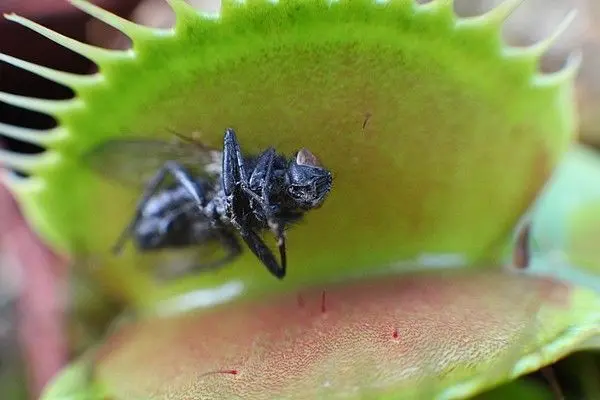
Rest assured, the plant wasn’t faking it. The insect does indeed appear intact, but if you take the trouble to prod it with a twig, you’ll find that it’s… empty. The digestive juices have indeed dissolved and then absorbed the flesh. All that remains is its exoskeleton, which the enzymes are unable to dissolve. This outer shell, called chitin, usually covers the entire body of insects. In short, the Venus flytrap has done its job, and done it rather neatly!
People often ask whether they should remove the remains once the trap has opened again. You’re under no obligation to do so, except that your carnivorous plant will look ‘neater’. What’s more, you risk it closing unexpectedly. In any case, the wind or rain will always take care of it in the end, if you’ve had the good sense to put your plant outside.
My Dionaea isn’t growing/is producing tiny traps/isn’t producing any traps at all/has no colour other than green. What should I do?
These are very often the result of insufficient light. A Venus flytrap grown in conditions that are too dark will grow slowly, producing broad, misshapen, uniformly green leaves, with a trap at the tip that is disproportionately small compared to the petiole, or even non-existent (at this stage, it’s urgent to take action!).
Even a room that is bright by human standards is rarely bright enough for a Venus flytrap. It needs a certain number of hours of direct sunlight during its growing season. To maximise your chances, don’t just count the hours – put it outside!
Light levels are often to blame, as the main mistake is to place a newly purchased plant indoors; however, if such symptoms appear, do check the condition and composition of the growing medium, as well as the source of the watering, just in case.
My Venus flytrap is flowering. I’ve read that you should cut the flowers off: is that true?
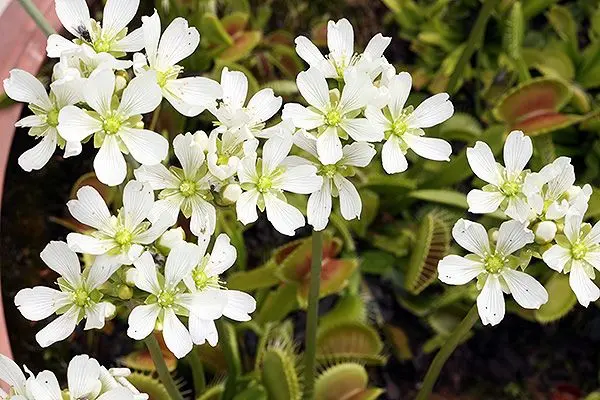
Some growers advise cutting off the flowers of Venus flytraps because the flowering process weakens the plant. If your plant is healthy and well-acclimatised (having been in place for several months), the only effect will be a slight slowdown in leaf production, with slightly smaller traps. You can always cut off the flower stalk if you want to keep the plant growing at its best, but this will inevitably mean you miss out on the seeds and the sight of those little white flowers.
If your plant is weak or has recently been planted bare-rooted, it may not be able to cope with flowering. In this case, cut the flower stalk, but wait until it is about ten centimetres long before doing so. Otherwise, your Venus flytrap may produce a new one…
Should I cut off the black parts?
It doesn’t really matter for the plant itself. But a plant without dead leaves certainly looks nicer! If you wish to remove them, wait until they are completely black, then gently pull on them. They should come away easily. If they don’t, don’t force them: this means there is still a healthy part remaining, and removing a healthy part will damage the plant!
FAQ – Caring for Dionaea muscipula
Why are the traps on my Dionaea black?
The darkening of the traps may be due to excess water, root rot or the natural end of a trap’s life.
Explanation: An old-growth Dionaea’s traps may die off after a few digestion cycles or during a period of dormancy. If cared for incorrectly (calcareous substrate, tap water, pot without drainage), the plant may suffer and its traps may change colour. Check the growing medium, repot if necessary, and water only with rainwater or demineralised water.
plante-carnivore.fr
When should I repot my Dionaea?
The best time is late March/early April, just before the plant starts growing again.
Explanation: A standard repotting using fresh compost (light-coloured peat + sphagnum moss + perlite/vermiculite) should be carried out before the plant enters its active growth phase. Repotting in late summer or autumn should be avoided, as the plant will have little time to recover before entering dormancy.
Do I need to feed my Venus flytrap in winter?
No: during dormancy, the plant does not require any feeding.
Explanation: During its winter dormancy period, trap activity is very low or even non-existent. The plant is no longer actively absorbing insects. Providing food or fertiliser at this time may cause the plant stress.
Why has my Dionaea stopped producing traps, or are they very small and green?
This very often indicates a lack of light or poor-quality substrate.
Explanation: A room that is bright enough for a human is not always sufficient for a Venus flytrap. It needs as much direct sunlight as possible. Furthermore, a growing medium containing calcareous materials or hard water reduces its effectiveness. Check the light exposure and the quality of the growing medium and watering.
Should I cut the flowers off my Dionaea?
It isn’t essential, but if the plant is young or under stress, it can help it focus its energy on its foliage.
Explanation: Flowering requires a lot of energy. If the plant is well-established, it will cope without any problems. Otherwise, cutting off the flower stalk before it draws too many resources is an option.
What sort of water should I use for my Venus flytrap?
Use only rainwater, osmosis water or demineralised water; never tap water or hard water.
Explanation: Hard water suffocates the roots of the Venus flytrap. This plant cannot tolerate excessive minerals. The growing medium must remain very moist, but not waterlogged.
Sources and references
Our experience :)
International Carnivorous Plant Society (ICPS)
A global reference guide for the cultivation and study of carnivorous plants.
https://www.carnivorousplants.org/
Royal Horticultural Society (RHS)
A recognised British horticultural organisation, providing reliable advice on the care of Dionaea muscipula.
https://www.rhs.org.uk/plants/venus-fly-trap/growing-guide
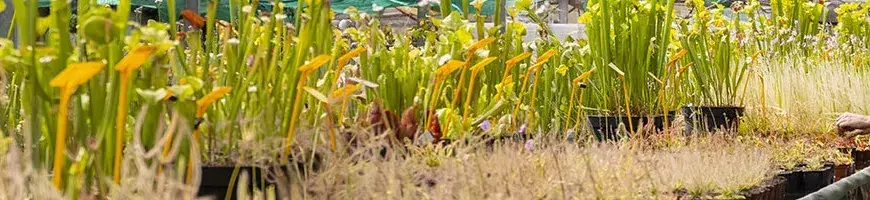
For sale in the Karnivores shop
Love Carnivorous plants? Don't miss our plants and exclusive offers in the online shop.
Read next
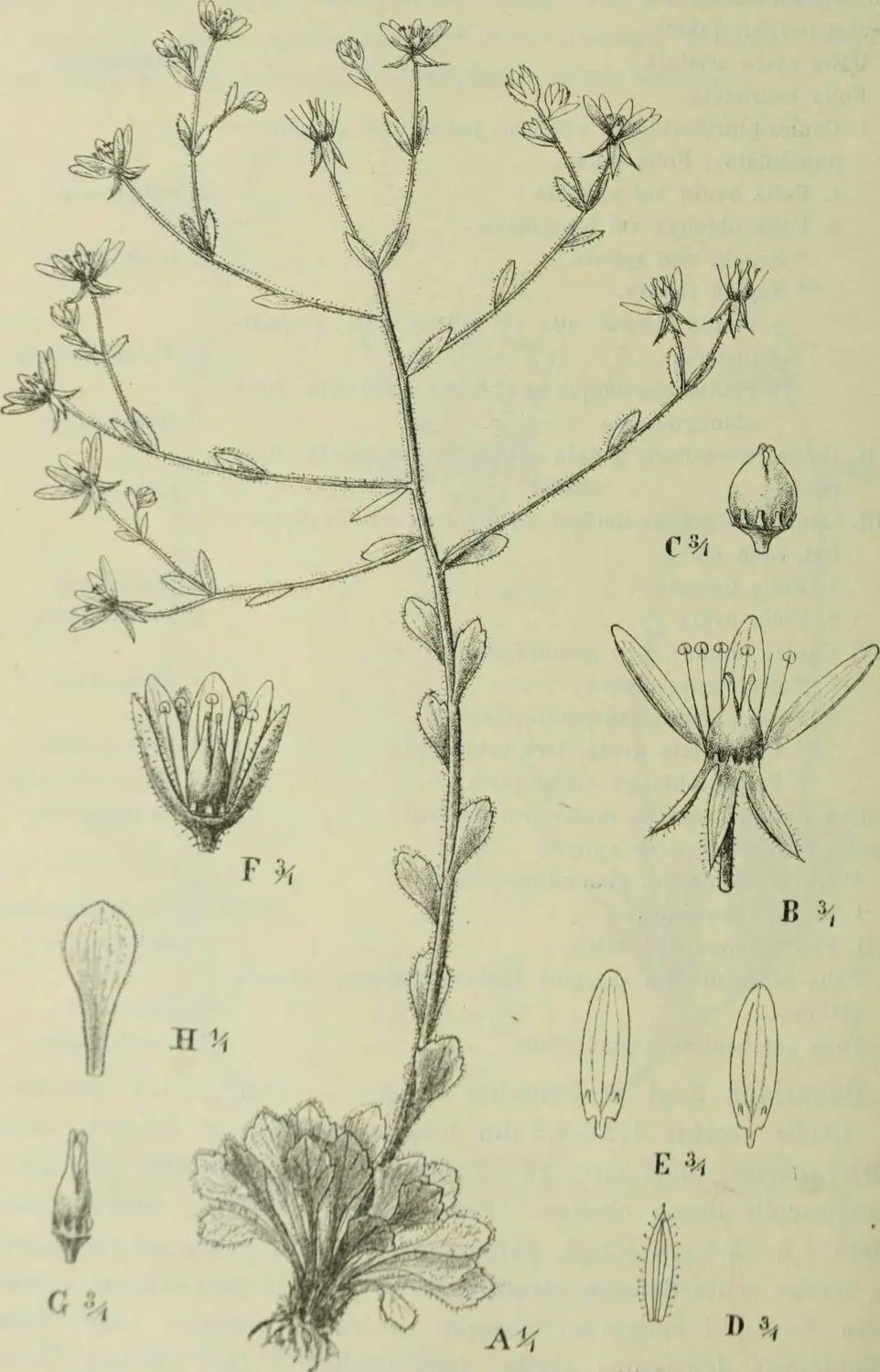
Saxifraga candelabrum: the flowering plant that confirms a 150-year-old hypothesis by Darwin
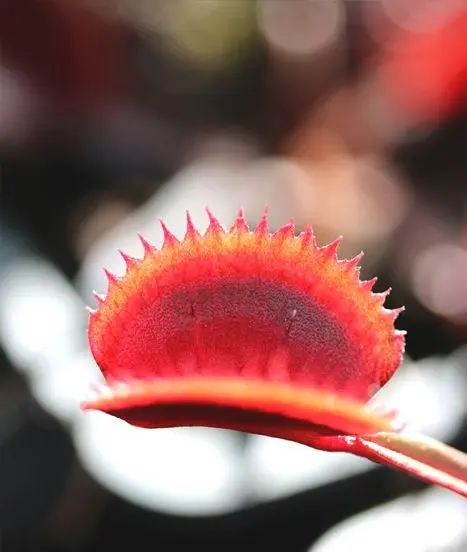
How does the Venus flytrap detect its prey? A 2025 study sheds light on its ‘sixth sense’
Growing Tillandsia from seed: a comprehensive guide to successful germination
Do Dionisian traps run on electricity?
How carnivorous plants digest their prey
Which plants can you grow on xaxim?