
The role of phyllodes
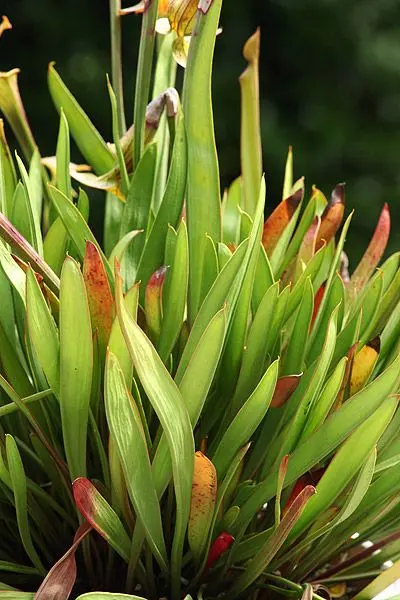
Unlike our beloved European Droseras, Sarracenias are not yet entering their dormant period. The pitcher plants are still fully capable of capturing and digesting prey, and new ones are still emerging from the rhizome, particularly in the case of Sarracenia leucophylla.
At the same time, we are seeing more and more simple leaves, which are in fact simply broad petioles: phyllodes.
The leaves that have been transformed into pitchers are optimised for carnivory, but this comes at the expense of their ability to capture light: they do not have enough surface area exposed to the sun in relation to their volume… Their production is therefore energy-intensive and cannot take place continuously, even outside the winter months. From mid-summer until late autumn, the phyllodes therefore gradually replace the pitcher-like structures.
In quantities proportional to the size of the rhizome, they enable the plant to store a great deal of energy thanks to their volume-to-illuminated-surface ratio, which is much higher than that of carnivorous traps. This allows the plant to recharge its batteries before the first frosts!
Another carnivorous plant, incidentally, uses a similar technique: the famous Cephalotus…

For sale in the Karnivores shop
Love Carnivorous plants? Don't miss our plants and exclusive offers in the online shop.
Read next
Saxifraga candelabrum: the flowering plant that confirms a 150-year-old hypothesis by Darwin
How does the Venus flytrap detect its prey? A 2025 study sheds light on its ‘sixth sense’
Growing Tillandsia from seed: a comprehensive guide to successful germination
Do Dionisian traps run on electricity?
How carnivorous plants digest their prey
Which plants can you grow on xaxim?