
Observation: prey of Drosera
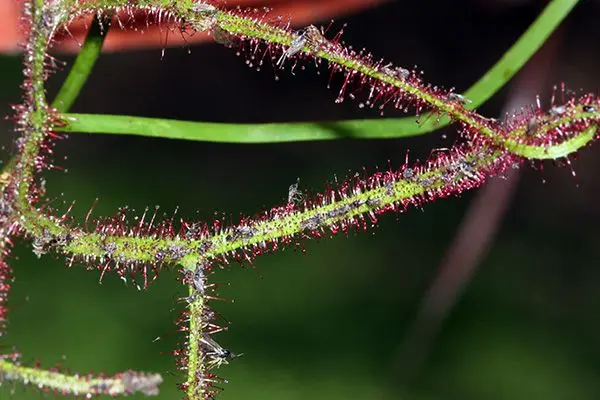
With the abundance of gnats that characterises this time of year, the **Drosera**s are having a field day: these are their main prey. This flying insect is attracted by the shiny droplets of sticky fluid. Being small, it is well-suited to the size of the tentacular leaves of these carnivorous plants, which are generally small, or at least not very wide. Being weak, it is unable to free itself and quickly becomes trapped in the sticky substance.
The rosettes lying flat on the ground generally catch fewer prey than the leaves above ground.
Most of the prey observed are midges, shown here at various stages of digestion. Smaller mosquitoes and other larger dipterans can also be seen, but their weak limbs prevent them from escaping. Some tentacles have folded over the prey to aid digestion.
This Drosera produces large, sticky, forked leaves in which flying insects are trapped with great ease!

For sale in the Karnivores shop
Love Carnivorous plants? Don't miss our plants and exclusive offers in the online shop.
Read next
Saxifraga candelabrum: the flowering plant that confirms a 150-year-old hypothesis by Darwin
How does the Venus flytrap detect its prey? A 2025 study sheds light on its ‘sixth sense’
Growing Tillandsia from seed: a comprehensive guide to successful germination

Do Dionisian traps run on electricity?
How carnivorous plants digest their prey

Which plants can you grow on xaxim?