
Ice trap
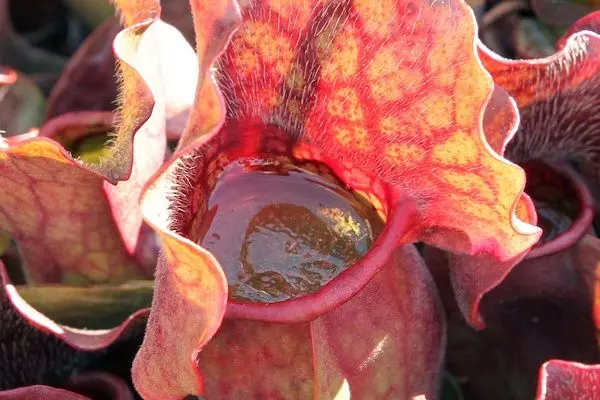
Following the cold spell in mid-December (very severe and prolonged frosts), we can see that the traps on our plants grown outdoors—in a large container of light-coloured peat exposed to the elements—are in perfect condition, so much so that the traps of *Sarracenia* purpurea quickly become encased in ice as soon as the temperature drops below the critical threshold.
Although it was completely frozen for several days, this plant did not lose a single leaf. In **Sarracenia** species with very upright pitchers, only the lower parts, over a greater or lesser length, remain alive in winter. The upper parts dry out as early as autumn, causing concern amongst novice growers. The mistake is then to bring them indoors! Whereas, with the cold, they will be all the more vigorous afterwards.
As mentioned in a previous article, a rhizome (or a piece of rhizome) may rot when the weather remains damp and dark for a prolonged period. *Sarracenia* leucophylla seems to be slightly more susceptible to this than other species.
For sale in the Karnivores shop
Love Carnivorous plants? Don't miss our plants and exclusive offers in the online shop.
Read next
Saxifraga candelabrum: the flowering plant that confirms a 150-year-old hypothesis by Darwin
How does the Venus flytrap detect its prey? A 2025 study sheds light on its ‘sixth sense’
Growing Tillandsia from seed: a comprehensive guide to successful germination
Do Dionisian traps run on electricity?
How carnivorous plants digest their prey
Which plants can you grow on xaxim?