
Everything you need to know about Sarracenia flowers
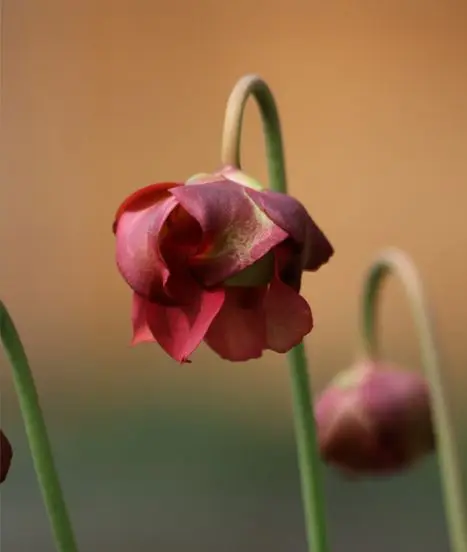
Sarracenia, those carnivorous plants with their spectacular pitcher-shaped flowers, have plenty of surprises in store for us. Whilst their traps are often the focus of attention, their flowers – which are more understated – also deserve our full attention. In this article, we’ll explore the characteristics, diversity and biology of these fascinating flowers.
A surprising display of flowers
Contrary to the image we often have of carnivorous plants, which generally have a sombre and intriguing appearance, the flowers of Sarracenia bring a touch of colour and delicacy. Their shape and colours vary depending on the species, ranging from pale yellow to deep red, with shades of pink and purple in between.
Why do pitcher plants flower?
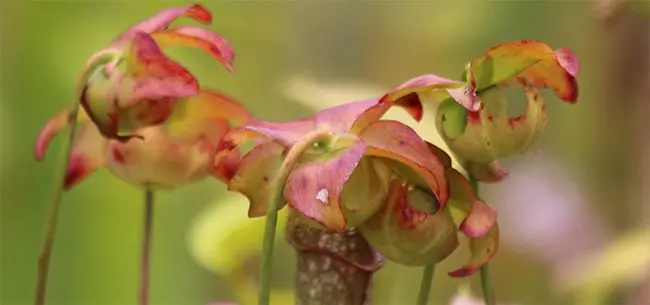
Flowering is an essential stage in the life cycle of pitcher plants, as it enables sexual reproduction. The flowers produce nectar to attract pollinating insects, mainly bumblebees, which carry pollen from one flower to another.
The structure of the flower
A Sarracenia flower is made up of several parts:
- The peduncle: This is the stem that supports the flower and raises it above the leaves, thereby reducing the risk of self-pollination.
- The sepals: Usually green in colour, they protect the flower before it opens.
- The petals: Often colourful and sometimes delicately scented, they attract pollinators.
- The stamens: These produce the pollen.
- The pistil: This is the female organ of the flower, which receives the pollen and contains the ovules.
Pollination: a complex mechanism
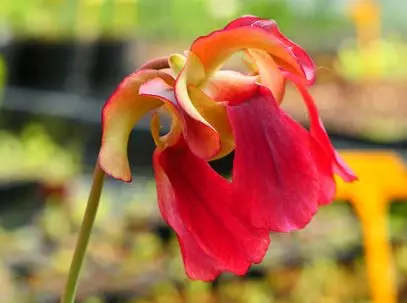
The pollination of Sarracenias is a fascinating process, as we have already seen in another article. Pollinating insects, attracted by the nectar and the bright colours of the flowers, slip inside to reach the nectar glands. As they move about, they come into contact with the stamens and the pistil, thereby facilitating pollination.
Seed formation
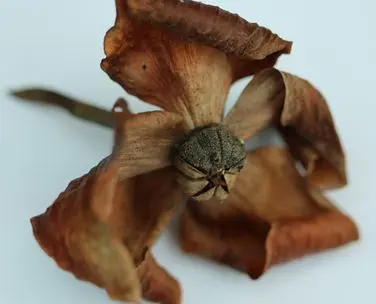
After fertilisation, the flower’s ovary develops into a fruit containing numerous seeds. These seeds can be dispersed by the wind, water or animals.
Growing flowering Sarracenia
To encourage your Sarracenia plants to flower, it is important to provide them with optimal growing conditions:
- Light: Sarracenia plants need plenty of light, ideally direct sunlight.
- Eau: The growing medium must always be kept moist, but avoid overwatering, which can cause root rot.
- Temperature: Sarracenia plants thrive on temperature fluctuations between day and night.
- Overwintering: A period of winter dormancy is necessary to encourage flowering.
In conclusion
Sarracenia’s flowers are much more than mere ornaments. They play an essential role in the reproduction of these fascinating carnivorous plants. By observing these delicate flowers closely, we can better understand the evolutionary strategies that have enabled these plants to adapt to their environment.
FAQ — Sarracenia Flowers
Why do Sarracenia flowers deserve so much attention?
Because they stand in contrast to the sometimes sombre appearance of carnivorous plants, offering delicate shapes and a variety of colours ranging from pale yellow to deep red.
Why do Sarracenia plants flower?
Flowering enables sexual reproduction. Flowers produce nectar to attract pollinating insects, particularly bumblebees, which transport the pollen.
How is a Sarracenia flower structured?
It consists of a stalk that supports the flower, protective sepals, colourful petals, stamens containing pollen, and a pistil that receives the pollen.
How does pollination work in Sarracenia?
Insects, attracted by the colours and nectar, slip into the flower and, as they move about, touch the stamens and the pistil, thereby facilitating pollination.
How do seeds form in Sarracenia?
After fertilisation, the ovary develops into a fruit containing numerous seeds, which are then dispersed by the wind, water or animals.
How can you encourage Sarracenia to flower when grown in pots?
They need plenty of light, a substrate that is kept moist but not waterlogged, a difference between day and night temperatures, and a period of dormancy.
Do flowers have any significance other than aesthetic?
Yes, they are essential for reproduction and enable us to observe the evolutionary strategies of carnivorous plants.
Sources and references
Our experience :)
North Carolina Extension (NC State University)
Sarracenia
https://plants.ces.ncsu.edu/plants/sarracenia/
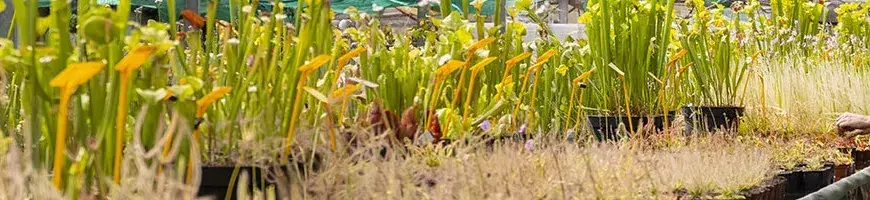
For sale in the Karnivores shop
Love Carnivorous plants? Don't miss our plants and exclusive offers in the online shop.
Read next
Saxifraga candelabrum: the flowering plant that confirms a 150-year-old hypothesis by Darwin
How does the Venus flytrap detect its prey? A 2025 study sheds light on its ‘sixth sense’
Growing Tillandsia from seed: a comprehensive guide to successful germination
Do Dionisian traps run on electricity?
How carnivorous plants digest their prey
Which plants can you grow on xaxim?