
A guide to sowing carnivorous plant seeds: how to ensure successful germination
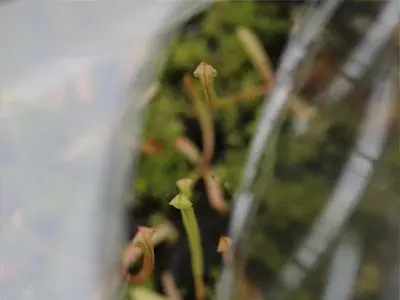
Stratification of carnivorous plant seeds is an essential step for certain species to break dormancy and trigger successful germination. Many seeds of Sarracenia, Dionaea and certain Drosera species require a controlled period of cold to replicate natural winter conditions.
In this article, you’ll discover how to stratify carnivorous plant seeds correctly, which species are affected, the ideal stratification duration and the mistakes to avoid, particularly mould problems. A simple method, accessible to everyone, to significantly improve the germination rate before sowing.
I. Seeds of Dionaea muscipula, Drosera, Sarracenia, Cephalotus and Darlingtonia
Before sowing, the seeds of Dionaea, Sarracenia and Darlingtonia can be kept at between 2 and 8°C for 8 to 12 weeks to achieve a better germination rate. This period in a cool environment is called stratification. This process breaks the seed’s dormancy.
Growing medium for sowing Dionaea muscipula, Drosera, Sarracenia and Cephalotus seeds, as well as Darlingtonia
Use either pure white sphagnum peat or a mixture of white peat and perlite/vermiculite (2 parts peat to 1 part perlite/vermiculite). Thoroughly moisten the growing medium with soft water and fill the pot intended for the seeds.
Sowing Dionaea muscipula, Drosera, Sarracenia and Cephalotus seeds, as well as Darlingtonia
Place the seeds on a sheet of paper and then sprinkle them directly onto the moist growing medium.
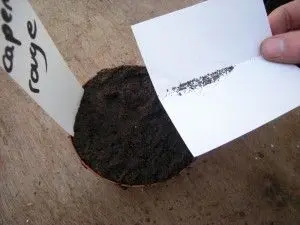
Place the pot in a warm, bright spot, between 20 and 25°C (behind a south- or south-west-facing window), with a saucer of water underneath to keep the compost moist.
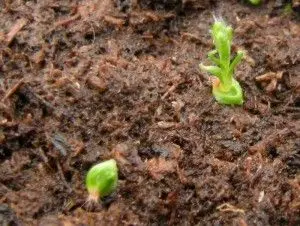
Within a few weeks, the first seeds will germinate:
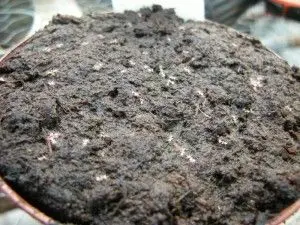
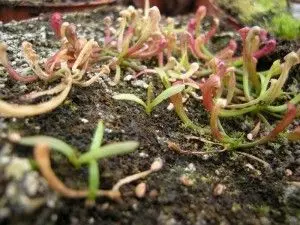
Tips for these seedlings
Ideally, to maximise germination, sow the seeds between January and April under an essential source of artificial light (horticultural fluorescent tubes or turbo fluorescent tubes). You can also place your seed trays or sow your seeds directly in a mini greenhouse, which will maintain a humid and warmer environment.
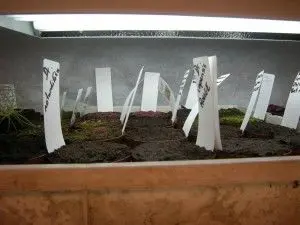
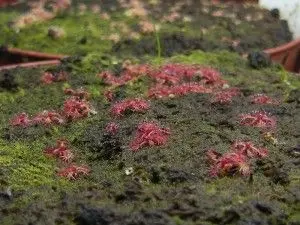
This ensures that you have young plants ready for transplanting in the spring, which will have time to grow stronger before autumn.
II. Gems of the pygmy Droseras
Towards the end of the year, pygmy Droseras (Drosera scorpiodes, Drosera pulchella, etc.), all native to Australia, have the distinctive feature of producing gemmae. These buds are not considered to be seeds, as they do not result from pollination. They enable the plant to clone itself by producing between 20 and 50 propagules, which will grow into new plants identical in every respect to the parent plant as soon as they fall to the ground.
Growing medium for pygmy Droseras
Use either pure white sphagnum peat or a mixture of white peat and perlite/vermiculite (2 parts peat to 1 part perlite/vermiculite). Thoroughly moisten the growing medium with soft water and fill the pot intended for the gemmae.
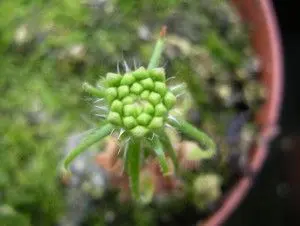
Sowing pygmy Drosera
Harvesting takes place when the offshoots begin to detach themselves from their parent plant. Harvest them by scraping them off onto a sheet of paper, then place the offshoots on the moist growing medium:
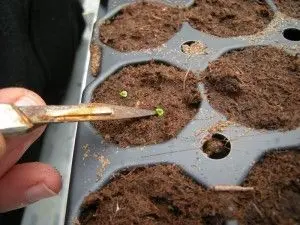
A tip for these seeds
The seeds can be stored for a few weeks. To do this, place them in an airtight container, away from moisture and light. This means you can harvest them in winter and sow them as early as February or March.
III. Nepenthes seeds
The growing medium for Nepenthes seedlings
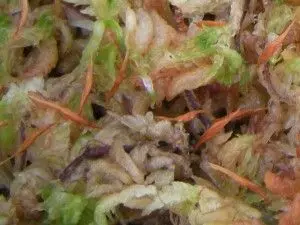
Simply use rehydrated sphagnum moss!
Nepenthes sowing
Place the seeds on a sheet of paper and then sprinkle them directly onto the rehydrated sphagnum moss.
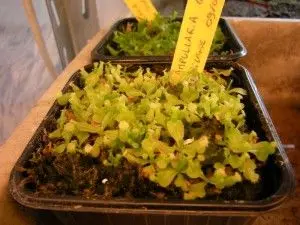
It will be a few months before the young plants are ready for transplanting:
The trick to growing these seedlings
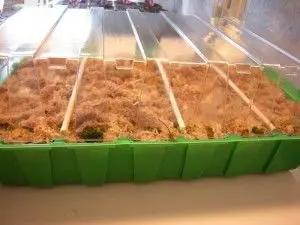
As Nepenthes are tropical plants, turbo-neon lights and a mini-greenhouse are essential to provide the light intensity and controlled environment required for Nepenthes seeds to germinate.
FAQ: Sowing carnivorous plants
When is the best time to sow carnivorous plants?
Seeds are sown in late winter or early spring to make the most of the increasing light, but some tropical species can be sown all year round provided there is sufficient light and warmth.
What growing medium should be used to ensure successful sowing of carnivorous plants?
A light, acidic mix is essential, usually consisting of sieved blond peat and sand or perlite, in order to achieve a well-draining but unamended growing medium.
Should the seeds be covered when sowing?
No. The seeds of carnivorous plants are very small and should simply be placed on the surface, without any layer of compost on top, as they need light to germinate.
Should the seeds of carnivorous plants be stratified?
Some temperate species require cold stratification lasting several weeks in order to break their dormancy, whereas tropical species do not need this.
What levels of moisture and exposure are required for germination?
The seedlings must be kept constantly moist in a saturated environment, often under cover or in a hotbed, whilst being exposed to bright but not scorching light.
How long does it take for the seeds of carnivorous plants to germinate?
Depending on the species, germination can take anywhere from a few weeks to several months, and some seeds require a great deal of patience before the first seedlings appear.
Sources and references
Our experience :)
International Carnivorous Plant Society (ICPS)
Guide to germination and cultivation
https://www.carnivorousplants.org/
For sale in the Karnivores shop
Love Carnivorous plants? Don't miss our plants and exclusive offers in the online shop.
Read next
Saxifraga candelabrum: the flowering plant that confirms a 150-year-old hypothesis by Darwin
How does the Venus flytrap detect its prey? A 2025 study sheds light on its ‘sixth sense’
Growing Tillandsia from seed: a comprehensive guide to successful germination
Do Dionisian traps run on electricity?
How carnivorous plants digest their prey
Which plants can you grow on xaxim?