
The plant that ‘feels’ touch: discovering the Venus flytrap’s tactile sensor
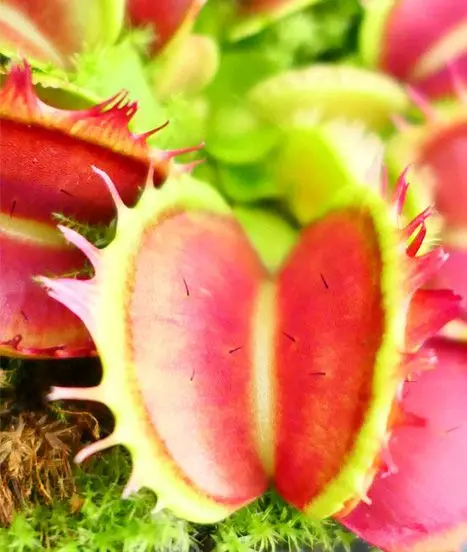
The famous Dionaea muscipula, better known as the Venus flytrap, continues to surprise scientists. A new study published in late September 2025 in *Nature Communications* has finally revealed the secret behind its sense of touch: a mechanosensory channel called DmMSL10.
🧬 An ultra-sensitive mechanosensor
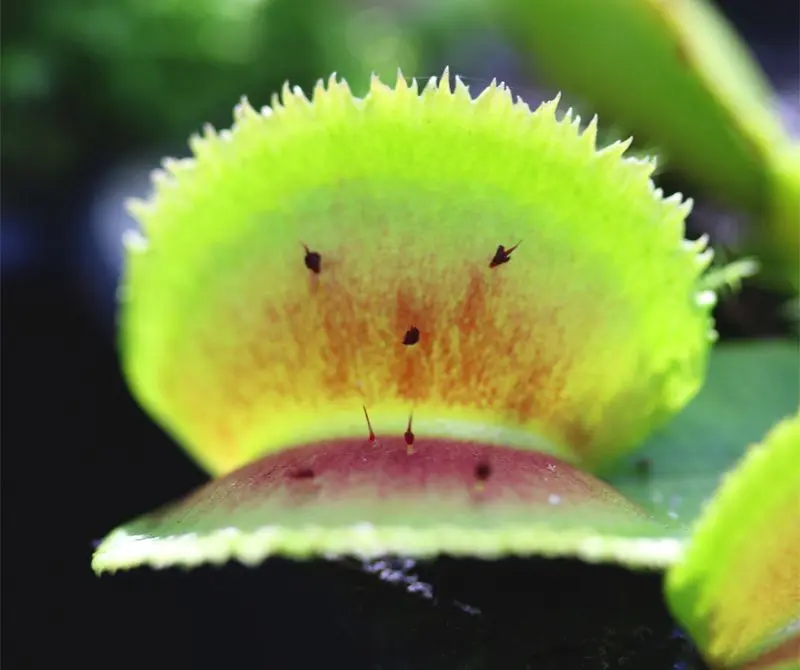
Researchers have identified DmMSL10 as a highly sensitive mechanosensor, located at the base of the Venus flytrap’s sensory hairs. These hairs, situated inside the trap, detect even the slightest contact with an insect.
When a mechanical stimulus — such as an insect’s leg brushing against it — activates this sensor, it triggers a cascade of electrical and calcium signals within the leaf.
How a simple touch sets a trap
Scientists describe a two-stage response:
- Local reception: the ‘indented’ cells around the hair sense pressure and generate a small electrical signal, known as a receptor potential.
- Trigger threshold: if the stimulus exceeds a certain intensity or speed, this signal becomes an action potential which spreads throughout the leaf.
This electrical signal is accompanied by a wave of calcium which instructs the trap to snap shut in a fraction of a second.
Experiments at the interface between plant and nervous systems
To observe these phenomena, the researchers combined fluorescent calcium imaging (using a GCaMP6f sensor) with ultra-precise electrical recordings.
In plants in which the DmMSL10 gene has been knocked out, the electrical response is much weaker: the traps only react to strong stimuli. As a result, these mutant Venus flytraps capture fewer insects.
A plant’s sense of touch
This discovery shows that the Venus flytrap does not merely ‘react’ mechanically: it perceives and assesses touch.
The DmMSL10 channel acts in much the same way as our tactile receptors: it translates physical deformation into a biological signal. Quite a feat for a plant!
Why it matters
Beyond the world of carnivorous plants, this study sheds light on a fundamental mystery: how plants perceive their environment.
Mechanosensitive channels such as DmMSL10 are also found in other plants, where they detect wind, rain or soil pressure. In the Venus flytrap, evolution has adapted them for… hunting.

For sale in the Karnivores shop
Love Carnivorous plants? Don't miss our plants and exclusive offers in the online shop.
Read next
Saxifraga candelabrum: the flowering plant that confirms a 150-year-old hypothesis by Darwin
How does the Venus flytrap detect its prey? A 2025 study sheds light on its ‘sixth sense’
Growing Tillandsia from seed: a comprehensive guide to successful germination

Do Dionisian traps run on electricity?
How carnivorous plants digest their prey

Which plants can you grow on xaxim?