
Pinguicula cuttings in perlite
Pinguiculas native to Mexico thrive in mineral-rich substrates, and with good reason – they are sometimes found growing alongside cacti in rockeries! In cultivation, hybrids such as Pinguicula x ‘Tina’ are very hardy and thrive in partially peaty soil.
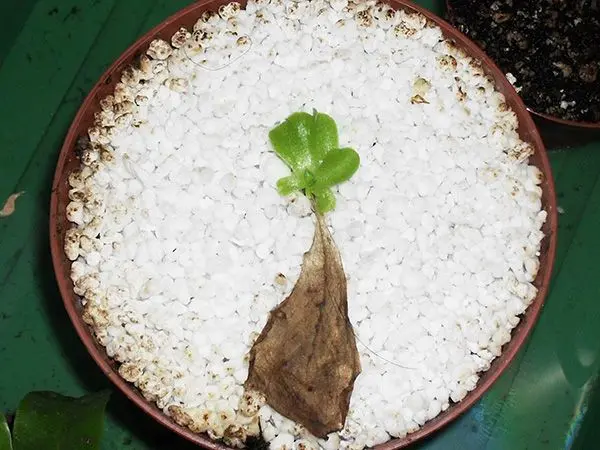
To propagate these carnivorous plants, taking cuttings is an excellent method. You need to take a healthy, whole leaf and press it against the growing medium, with the tip of the petiole (the thinner part connecting the leaf to the ‘body’ of the plant) pointing downwards. Here is an illustration showing a cutting by Grégory Gardin, a passionate amateur, grown in 100 per cent perlite.
The dead leaf is the one that was sacrificed for propagation. A new, perfectly healthy plant has formed from the petiole. The process begins with the emergence of roots, followed by the first (tiny) leaves. You’ll need to be patient: it takes a few weeks. The air humidity must be high enough to keep the leaf moist and allow it to root. Perlite significantly reduces the risk of rot, as it provides excellent drainage.
For sale in the Karnivores shop
Love Carnivorous plants? Don't miss our plants and exclusive offers in the online shop.
Read next
Saxifraga candelabrum: the flowering plant that confirms a 150-year-old hypothesis by Darwin
How does the Venus flytrap detect its prey? A 2025 study sheds light on its ‘sixth sense’
Growing Tillandsia from seed: a comprehensive guide to successful germination
Do Dionisian traps run on electricity?
How carnivorous plants digest their prey
Which plants can you grow on xaxim?