
Cryptanthus, Earth Star: Growing Guide
Introduction
Cryptanthus, also known as the Earth Star, is an exotic houseplant highly prized for its decorative rosettes and star-shaped foliage. Native to Brazil and renowned for its hardiness, it thrives equally well indoors and in terrariums. Discover what makes this terrestrial bromeliad an ideal plant for decorative displays and cultivation in a controlled environment.
Origin and key characteristics of Cryptanthus
Cryptanthus, often called the Earth Star, is an exotic houseplant belonging to the Bromeliad family. Native to the dry forests of eastern Brazil, this genus comprises around sixty terrestrial species that form decorative rosettes. Unlike Tillandsias, which also belong to the Bromeliad family, Cryptanthus does not grow as an epiphyte but directly on humus, tree stumps or rocky areas within its natural habitat.
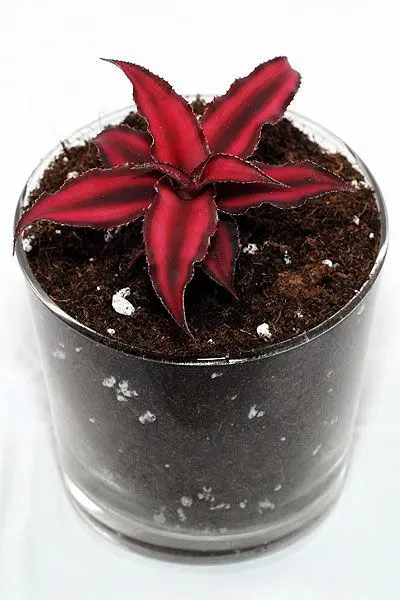
This plant is prized for its leathery, textured and often spectacular foliage. Its serrated and wavy leaves are arranged in a star-like pattern around a central axis, which gives it its nickname. The colours become more vivid in bright light, offering considerable decorative appeal, particularly in Cryptanthus bivittatus, which develops a contrasting longitudinal vein. An important feature is that the mother plant continues to grow after flowering and gradually produces new rosettes, unlike other Bromeliads which die back after flowering.
Growing Cryptanthus indoors, in terrariums and paludariums
A hardy and easy-to-grow plant, Cryptanthus is ideally suited to growing indoors, in a terrarium or in a paludarium. It thrives in moderate to high ambient humidity and soil kept slightly moist. Due to its underdeveloped root system, it can remain in the same substrate for several years without requiring frequent repotting.
Origin and natural habitat
Cryptanthus species are endemic to Brazil, found mainly in the dry forests of the east. They grow at ground level, often on organic debris, in forest humus or in rock crevices. Their terrestrial adaptation sets them apart from many other members of the Bromeliaceae family. This environment provides them with filtered light, variable humidity and well-drained yet nutrient-rich soil.
Botanical characteristics of Cryptanthus
The rosette measures between 15 and 40 cm, depending on the species and growing conditions. The leaves are stiff, thick, often marked with decorative striations and arranged in a star shape. The foliage can range from deep green to pink, red, brown or cream, depending on the variety and light intensity. Cryptanthus bivittatus is particularly prized for its vibrant colour and elegant central stripe.
After flowering, the plant does not die. It continues to grow and naturally produces offshoots, allowing the rosette to become fuller and multiply over the years.
Growing conditions for Cryptanthus
Light
: Cryptanthus thrives best in bright but indirect light. Insufficient light causes the colours to fade.
Watering
The soil should remain slightly moist. The plant is sensitive to overwatering, as its shallow root system does not tolerate waterlogging well.
Humidity
: In an open environment, regular misting is beneficial. In a terrarium or paludarium, the natural humidity is sufficient for the plant’s comfort.
Temperature
It is an ideal houseplant, tolerating moderate to warm indoor temperatures well.
Substrate and roots
As the roots serve mainly to anchor the plant, it can remain in the same pot for a long time. A well-draining, slightly acidic soil, enriched with organic matter, is recommended.
Conclusion
Cryptanthus stands out as an ideal houseplant for those seeking an exotic, striking and easy-to-grow species. Perfect in a terrarium, paludarium or simply in a pot, it boasts unique foliage that adds an instant decorative touch. Thanks to its hardiness, sustained growth after flowering and simple requirements in terms of light and humidity, the Earth Star remains an excellent choice for all plant lovers, from beginners to enthusiasts. Whether to enhance a collection or add a touch of beauty to an indoor space, Cryptanthus is a sure-fire choice for plant-based décor.
FAQ – Cryptanthe, Earth Star
What distinguishes Cryptanthus from other Bromeliads?
Cryptanthus is primarily terrestrial, has leathery leaves arranged in a star shape and continues to grow after flowering, unlike other Bromeliaceae.
Where does the nickname ‘Étoile de Terre’ come from?
This is due to the star-shaped form of its rosette, whose leaves radiate perfectly around a central axis.
What type of light is best for Cryptanthus?
A bright but indirect light that brings out the colours of the foliage without the risk of scorching.
How should you water a Cryptanthus properly?
The soil should be kept slightly moist, without being waterlogged. Waterlogging can lead to root rot.
Is Cryptanthus suitable for terrariums?
Yes, it thrives there thanks to the stable humidity and diffused light.
Does the Cryptanthus die after flowering?
No, the mother plant continues to grow and produces new rosettes over the years.
Sources and references
Our experience :)
Florida Council of Bromeliad Societies
https://fcbs.org/pictures/Cryptanthus.htm
University of Arkansas
Cryptanthus hybrids; Earth Star
https://www.uaex.uada.edu/yard-garden/resource-library/plant-week/Cryptanthus-hybrids-Earth-Star-06-07-2019.aspx
For sale in the Karnivores shop
Love Exotic animals and terrariums? Don't miss our plants and exclusive offers in the online shop.
Read next
Cyrtomium fortunei: an evergreen fern ideal for shaded areas
Asplenium trichomanes: wall fern – growing, origin and tips
Ficus pumila: growing, care and tips
How to secure the xaxim in a terrarium so that it stays in place safely and securely
Plectranthus ernestii: an ideal, striking plant for a terrarium
A comprehensive guide to growing Neoregelia in a terrarium