
Cold-induced redness
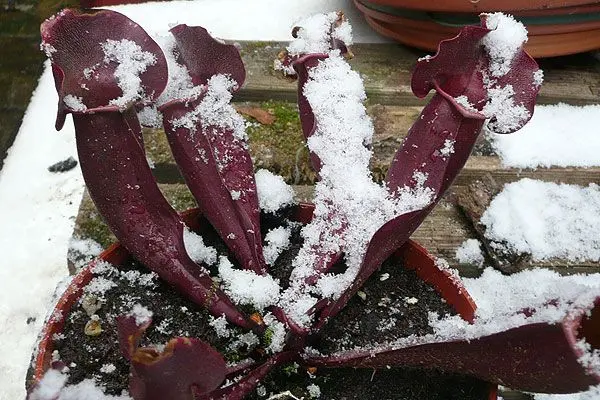
The foliage of hardy, perennial carnivorous plants turns red as soon as temperatures drop below 0°C. This phenomenon is particularly striking in certain Sarracenia species whose foliage persists through the winter. Sarracenia purpurea is one such species, though it is difficult to notice as this species is naturally red to purple in colour…
Sarracenia purpurea ‘Sorrow’, one of the few Sarracenia species that is – almost – entirely green, is grown in cool conditions in our greenhouses, at temperatures between 2 and 10°C in the depths of winter. Once it arrived at the grower’s, one specimen was exposed to frost (to which it is highly resistant). The pigment reaction was swift: the entire foliage turned from green to purple, giving it a passing resemblance to Sarracenia x courtii!
The change is dramatic, and yet the plant is in good health and perfectly in line with its natural cycle. In a few weeks’ time, after dormancy, the new leaves will once again take on their usual colour. The older leaves, meanwhile, will slowly wither away over the course of the year.
For sale in the Karnivores shop
Love Carnivorous plants? Don't miss our plants and exclusive offers in the online shop.
Read next
Saxifraga candelabrum: the flowering plant that confirms a 150-year-old hypothesis by Darwin
How does the Venus flytrap detect its prey? A 2025 study sheds light on its ‘sixth sense’
Growing Tillandsia from seed: a comprehensive guide to successful germination

Do Dionisian traps run on electricity?
How carnivorous plants digest their prey
Which plants can you grow on xaxim?