Tillandsia: a brief look at its anatomy
Introduction
Tillandsias are fascinating epiphytic plants belonging to the Bromeliaceae family. Among their most remarkable characteristics is their floral anatomy, which may appear very different from what is usually observed in other flowering plants. Understanding the anatomy ofTillandsia flowers helps us to better appreciate their structures, adaptations and aesthetic features. In this article, we detail the most striking anatomical features of Tillandsia, including the structure of the inflorescence, the arrangement of the petals and the variations between species.
An extraordinary floral anatomy
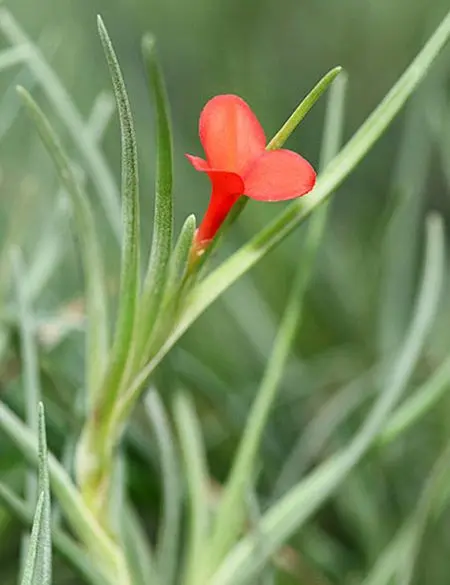
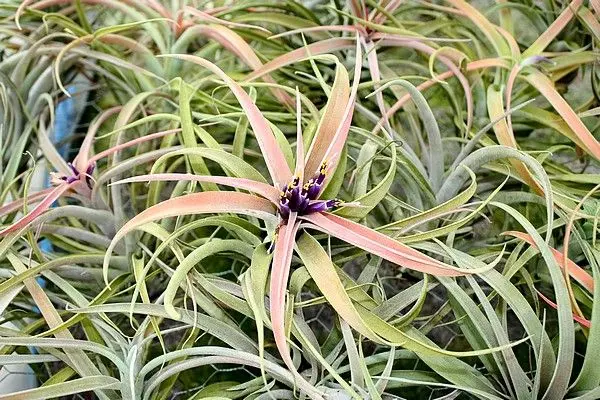
Just like the plants themselves, Tillandsia flowers are out of the ordinary. Unlike many plants, which have petals arranged in a regular corolla, Tillandsia often display unique floral structures, where the petals may be tubular or arranged in different ways. Sometimes, the intensely coloured parts of the flowers contrast sharply with the traditional image we have of a flower, which adds to their visual and botanical appeal.
The inflorescence: the heart of flowering in Tillandsia
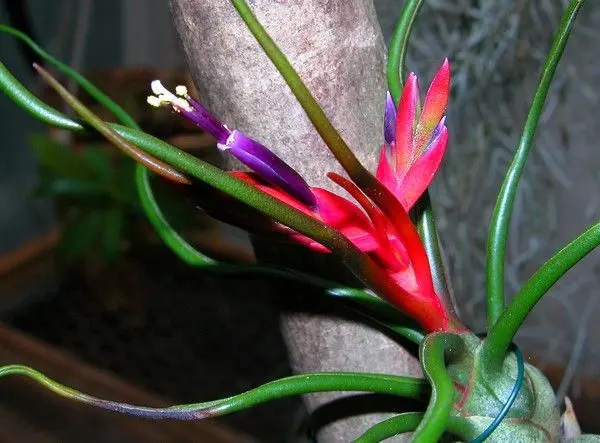
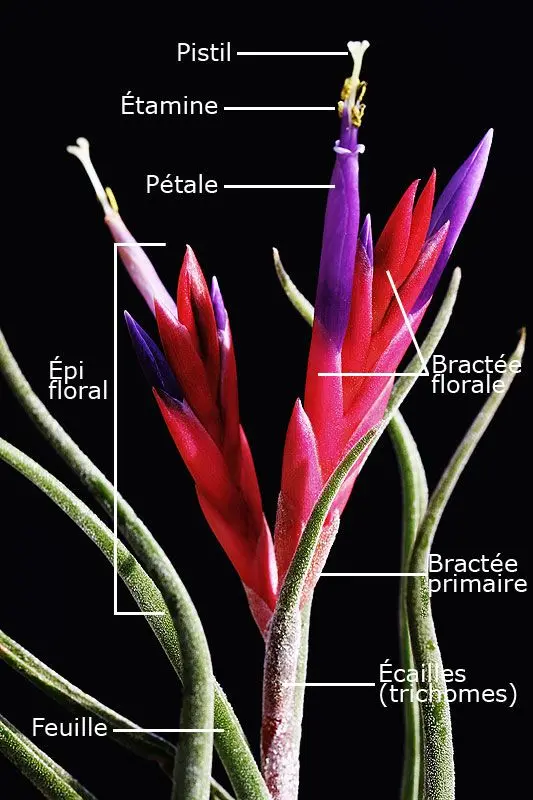
The inflorescence of a Tillandsia comprises all the plant’s flowers and includes various important parts that are not always immediately visible. Some specimens have highly elaborate inflorescences, whilst others may have simpler flowers that are nonetheless just as fascinating in terms of their shapes and colours. In some species, the inflorescences can be very showy, helping to attract pollinators, whilst in others they remain more discreet.
Variability in petals and floral scents
In many Tillandsia species, the petals unfold in unexpected ways to form structures that may appear exotic or unusual. Some species, such as Tillandsia cyanea, have some of the largest flowers in the genus, and their flowers are often fragrant, indicating functional diversity in reproduction and the attraction of pollinating insects.
Basic anatomical terminology for Tillandsia
To better describe the anatomy of Tillandsia, certain terms recur frequently:
- Inflorescence: the cluster of flowers and the structures supporting them.
- Petals: floral parts that are often colourful and sometimes fragrant.
- Floral structure: the general arrangement of the flower’s parts, which may be tubular, spreading or unusual compared to other plants.
These terms help to understand the morphological variety found within the Tillandsia genus.
Conclusion
The anatomy of Tillandsia, whilst unassuming in some cases, reveals a great diversity and originality that contribute to the charm of these epiphytic plants. Their striking flowers, the arrangement of the petals and the structure of the inflorescence often differ from what is observed in more common plants. Understanding these anatomical features enriches the experience of observing and growing Tillandsiae, whilst highlighting the ingenuity of evolution within the Bromeliaceae family.
FAQ – Tillandsia: a bit about its anatomy
What makes the floral anatomy of Tillandsia so distinctive?
The floral anatomy of Tillandsias is characterised by structures that often differ from those of conventional flowers, with petals that may be tubular or arranged in an unusual manner, as well as very distinctive coloured features.
What is an inflorescence in Tillandsia?
The inflorescence comprises all the flowers of a Tillandsia, together with the structures that support them. Some inflorescences are highly elaborate and conspicuous, whilst others are more inconspicuous, depending on the species.
Are Tillandsia flowers always showy?
No, depending on the species, flowers can be very showy or, conversely, more understated. In some cases, the inflorescence plays an important role in attracting pollinators.
Are there any Tillandsia with fragrant flowers?
Yes, some species, such as Tillandsia cyanea, have flowers that are often fragrant, which demonstrates functional diversity in reproduction and in attracting pollinators.
Which anatomical terms are essential for understanding Tillandsia?
The key terms are ‘inflorescence’, which refers to the cluster of flowers; ‘petals’, which are often colourful and sometimes fragrant; and ‘floral structure’, which describes the general organisation of the flower.

For sale in the Karnivores shop
Love Tillandsia? Don't miss our plants and exclusive offers in the online shop.