Spotlight on Tillandsia bulbosa
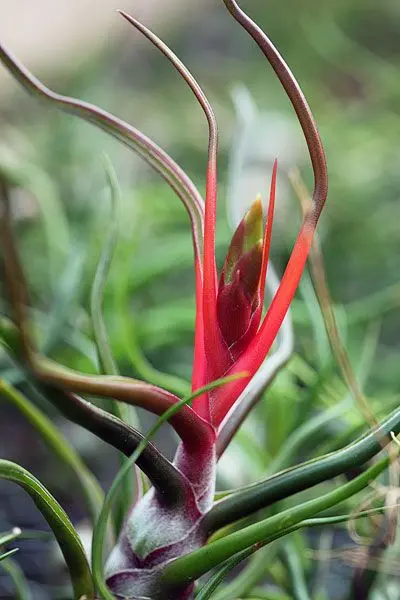
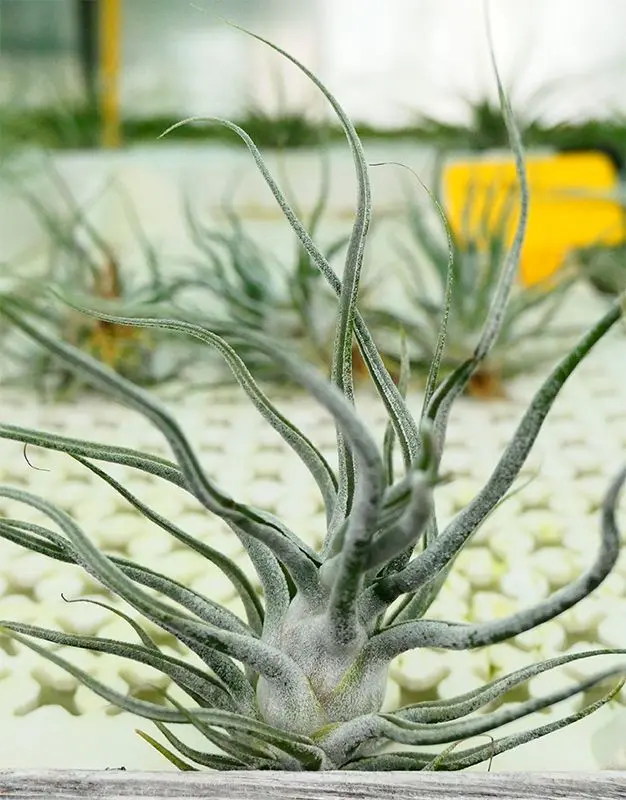
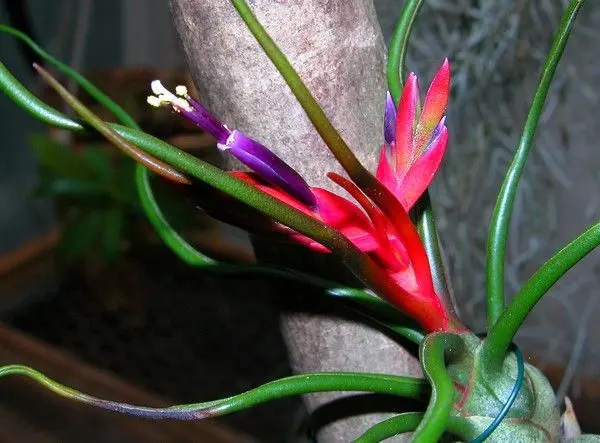
Tillandsia bulbosa is an epiphytic bromeliad described by Sir William Jackson Hooker, a British botanist, in 1825. It is native to an area stretching from Mexico to the West Indies and as far as Peru, including northern Brazil. It grows mainly at low altitudes (below 1,300 metres), suspended amongst the foliage of dense forests. Lacking a stem, it produces twisted, spindle-shaped leaves measuring up to 20 cm in length, which are dark green and grow in clumps from a bulb that divides after each flowering. The flowering process is spectacular: it begins with the upper leaf blades turning a deep red, a colour that subsequently spreads to all the spikes of the inflorescence. The flowers have tubular blue or purple petals, adding further contrast to the display.
Tillandsia bulbosa has two characteristics which, in addition to its striking appearance, help to make it a truly extraordinary plant. Indeed, it is one of the few Tillandsia species to be myrmecophilous: in the wild, nearly half of the specimens harbour ants! The leaves, rolled up to form a tube, provide an ideal shelter for the ants and their food… a small portion of which is absorbed into the plant’s tissues! Another distinctive feature: Tillandsia bulbosa is not subject to geotropism, meaning it defies gravity and grows in all directions (whereas most plants grow upwards by default)!
Cultivating Tillandsia bulbosa
It is prized for its striking appearance and hardiness, provided it is not placed in full sun and is allowed to dry out between waterings. The flowering process is a long one, allowing you to admire its vibrant colours for several weeks.
For sale in the Karnivores shop
Love Tillandsia? Don't miss our plants and exclusive offers in the online shop.