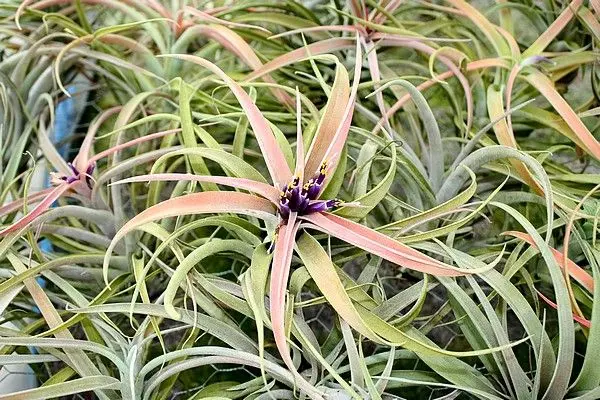
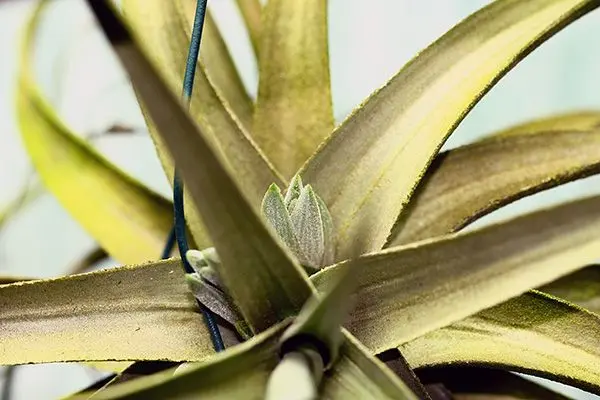
Tillandsia in their natural habitat
Introduction
Tillandsias in their natural habitat remain largely undocumented. On the internet, authentic photographs of these air plants in their natural setting are rare and valuable. We often have to rely on keen travellers and observant naturalists to gain access to this kind of visual record. Among them, François ‘Sockhom’ Mey shares remarkable images on his nature blog of Tillandsia growing freely in the wild, offering a unique insight into these epiphytic plants. We head to Florida, to the heart of landscapes where Tillandsia literally reign supreme.
Tillandsias observed in their natural habitat
The images shared show Tillandsias as they really live, far from any artificial staging. These photographs provide a better understanding of how these air plants naturally colonise their environment, settling on a variety of surfaces and sometimes forming veritable spontaneous plant compositions. Observing these natural scenes helps us to better understand the biology and behaviour of Tillandsia.
Myakka National Forest: an ecosystem rich in Tillandsia
Situated near the south-west coast of Florida, Myakka National Forest covers an area of approximately 35 km². This vast wooded area is home to a varied vegetation comprising pines, small palms, ferns of various sizes and numerous Tillandsia species. Notable species include the unassuming Tillandsia filifolia, as well as the famous Tillandsia usneoides – often known as Spanish moss – which grows abundantly on tree branches.
A naturally spectacular plant community
In this forest, certain branches are naturally covered with several species of Tillandsia. These spontaneous associations perfectly illustrate the ability of Tillandsias to coexist and utilise the same substrate without competing directly with one another. These natural compositions offer a striking glimpse of what a true kingdom of Tillandsias in the wild can be like.
Myakka National Park: a sanctuary for Bromeliads
A little further north lies Myakka National Park, one of Florida’s largest and oldest parks, covering approximately 150 km². This protected area is home to exceptional biodiversity, with numerous reptiles, amphibians, fish, mammals and, above all, a wide variety of rare birds. It is also an ideal place to observe Bromeliads, particularly Tillandsia.
Tillandsia usneoides and Tillandsia fasciculata: iconic species
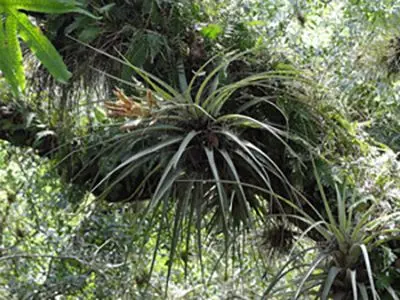
Within the park, splendid Tillandsia usneoides adorn the trees, forming long, hanging curtains of foliage. But another species attracts particular attention: Tillandsia fasciculata, often referred to as the giant Tillandsia. This very robust species can reach up to 1**.50 metres in diameter and around 1 metre in height**, whilst growing suspended several metres above the ground.
Giant Tillandsias hanging high
Despite their impressive size, these giant Tillandsias cling to trees, particularly the hemispherical acorn oak. Some specimens feature flower spikes that can reach up to 30 cm, further enhancing the spectacular appearance of these aerial plants. Faced with such a sight, the expression ‘the kingdom of Tillandsia’ takes on its full meaning.
Tillandsias and unusual hosts
Finally, some images show a sight that may puzzle the uninformed observer: Tillandsiasgrowing on electric wires. Whilst this may seem unthinkable, it is in fact a common occurrence in the regions where these plants grow naturally. The seeds of Tillandsia usneoides and Tillandsia recurvata can germinate on almost any surface, confirming their incredible adaptability.
Conclusion
This journey into the heart of Florida’s landscapes reveals the full power and diversity of the Tillandsia kingdom. Whether they colonise tree branches, form natural plant compositions, reach impressive sizes or take root on unexpected surfaces, Tillandsia demonstrate an extraordinary ability to adapt. Observing these epiphytes in their natural habitat not only provides a better understanding of their biology but also allows us to fully appreciate their raw, wild beauty.
FAQ – Tillandsia in their natural habitat
Why do we see so few photos of Tillandsia in their natural habitat?
Because photos of Tillandsias in their natural habitat are rare: you have to rely on passionate, generous travellers and explorers to be lucky enough to see them.
Where were the photos of Tillandsia mentioned in the article taken?
The photographs were taken in Florida, notably in the Myakka National Forest and Myakka National Park.
Which species of Tillandsia are found in the Myakka National Forest?
Notable among the plants here are the unassuming Tillandsia filifolia and the famous Tillandsia usneoides, known as ‘Spanish moss’, which colonises the branches of trees.
Which giant Tillandsia was spotted in Myakka National Park?
The giant Tillandsia mentioned is Tillandsia fasciculata, a very hardy species that can grow into very large plants whilst remaining suspended several metres above the ground.
Why do you sometimes find Tillandsia growing on electric wires?
Because the seeds of Tillandsia usneoides and Tillandsia recurvata can germinate regardless of the substrate – or rather, the surface they are growing on – which explains why they are found on electric wires.
Sources and references
Our own experience :)
For sale in the Karnivores shop
Love Tillandsia? Don't miss our plants and exclusive offers in the online shop.